What are SPVs? Analysing the AI data centre boom and how the financing works
AI needs a lot of computing power. And building the data centres behind it takes a lot of money. One way companies are helping fund that build-out is through special purpose vehicles, or SPVs.
SPVs aren’t new. They’ve been used for decades to finance everything from aircraft to toll roads. But in the AI boom, they’re becoming an increasingly important way for tech companies, chipmakers and infrastructure investors to fund massive data centre projects.
The basic idea is simple: instead of one company borrowing billions of dollars and putting all that debt on its own balance sheet, a separate legal entity is created to own and finance a specific project. Meta, Nvidia, OpenAI, Oracle and SoftBank’s SB Energy are among the companiesreported to be tapping into these innovative financing structures to help power their next-generation infrastructure.
So, what exactly is an SPV, how does it work and what should investors understand about the risks?
What are SPVs and how do they finance data centres?
An SPV is a separate legal entity created for a specific purpose. In this case, that purpose might be building and owning a data centre.
A tech company can partner with lenders or private credit investors to create the SPV. The SPV raises money, takes on debt and owns the data centre. The tech company then leases the facility or its capacity.
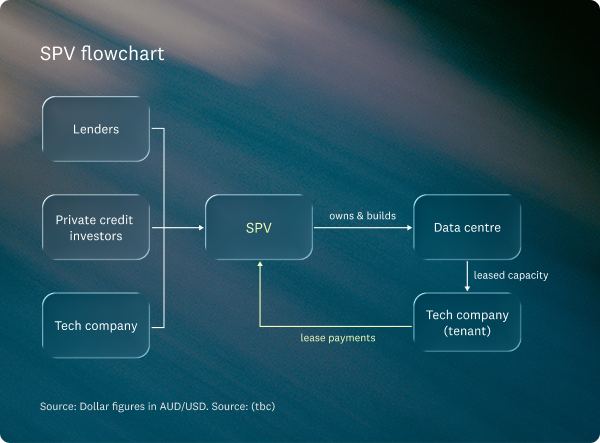
Because the SPV is legally separate from the parent company, the debt may sit outside the parent’s headline balance sheet. The company may instead report its investment in the project and its lease obligations, depending on how the arrangement is structured and accounted for.
These entities are often designed to be “bankruptcy remote”. In plain english, that means they’re structured to be legally separate enough to help protect the project and its lenders if the parent company runs into financial trouble. That doesn’t make the project risk-free. The debt still exists, someone still has to repay it. The structure simply changes where that debt sits and who is directly exposed to it.
As reported in the Financial Times, tech companies have moved more than US$120 billion of data centre spending off their balance sheets in roughly 18 months.
Inside the biggest AI data centre financing deals
Meta’s Hyperion data centre project in Louisiana is a useful example of the scale involved. The financing package totals around US $30 billion and was arranged through an SPV involving Morgan Stanley, Blue Owl, Pimco and Meta. Around US $27 billion is debt, reportedly raised through investment-grade bonds, while roughly US$2.5 billion is equity. Meta retains a 20% ownership stake in the project, with Blue Owl holding the remaining interest.
Did you know? The Hyperion site spans around 2,250 acres and nine or more buildings, with an initial capacity of 2 gigawatts that could eventually expand beyond 5 gigawatts.
Meta has also reportedly arranged another SPV worth more than US$13 billion for a data centre project in Texas, expected to come online in 2028.
Nvidia’s involvement in the broader AI infrastructure build-out looks different again. The chipmaker committed US$1.5 billion to SB Energy, which is developing an 8-gigawatt data centre in Ohio under a 20-year lease to OpenAI. OpenAI is expected to fill the facility with Nvidia GPUs, with some of the infrastructure financing connected to arrangements Nvidia has helped support.
Critics have described this type of arrangement as circular financing, because companies can appear in multiple parts of the same ecosystem: as investor, supplier, customer or financier. That doesn’t mean the transactions aren’t real. Nvidia founder Jensen Huang has publicly rejected the “circular financing” label, and Nvidia’s substantial free cash flow reflects real cash generation.
Did you know? Despite the size of these commitments, Nvidia’s debt-to-equity ratio sits at just 0.07, meaning it carries relatively little debt compared with its equity.
Still, the structure is worth understanding, because when companies are connected across several parts of the same financing chain, the health of one part of the system can affect the others.
The total value of these arrangements is difficult to pin down. One secondary outlet, 24/7 Wall St., reported estimates attributed to Nikkei and The Wall Street Journal that put off-balance-sheet AI obligations among major hyperscalers at between US $1.65 trillion and US $3 trillion. The numbers may be difficult to verify precisely, but the broader point is easier to see: the financing behind AI infrastructure is becoming increasingly interconnected.
Why companies use SPVs to finance AI data centres
The appeal is fairly straightforward. Data centres are expensive, long-lived assets that can operate for decades and are often backed by long-term agreements with large tenants. That makes them well suited to project-style financing. Instead of putting the full cost of a new data centre on one company’s balance sheet, an SPV can raise capital specifically for that project, linking the financing more closely to the asset itself.
This isn’t a new idea. Aircraft have long been financed through leasing structures and infrastructure such as toll roads and power plants have used similar arrangements for years.
The difference with AI data centres is the level of customer concentration. An aircraft leasing company may be able to find another airline if one customer stops leasing a plane. A data centre designed around one company’s specific power, cooling and computing requirements may be harder to repurpose. That’s an important distinction: a project can be legally separate from its parent company, but its economic success may still depend heavily on one tenant.
For chipmakers, there can also be another benefit. If a company helps finance infrastructure that ultimately enables customers to buy its hardware, it may benefit in more than one way, earning a return on its investment while also selling equipment into the project. Again, that isn’t automatically a problem, but it can create a more connected financial ecosystem than a simple supplier-and-customer relationship.
The risks behind AI data centre SPV
There are a few places where things could get complicated.
Legal risk: One question is whether assets transferred into an SPV would be treated as a genuine sale if the arrangement was challenged in court. If a court decided the transaction was effectively a secured loan rather than a true transfer of ownership, assets that appeared separate from the parent company could potentially be treated differently in a bankruptcy. It’s a technical legal issue, but the practical question is simpler: when things go wrong, who really owns the asset and who gets access to it?
Structural risk: The second risk is how closely connected these arrangements can become. A missed payment or problem in one part of a financing structure can sometimes have consequences elsewhere, particularly where contracts include cross-default provisions, meaning trouble with one debt arrangement can potentially trigger problems under another.
Google has backstopped US$1.8 billion of Fluidstack’s lease obligations to data centre operator TeraWulf, taking roughly an 8% equity stake in TeraWulf in return, an example of how tightly several companies can end up tied to the same financing chain.
Credit markets are already pricing some of this risk in. Moody’s flagged potential risks in Oracle’s AI infrastructure contracts in September 2025 without taking a ratings action and according to S&P Global data, Oracle’s credit default swaps closed in December 2025 at their highest level since 2009. The Bank of England has separately warned that the growing role of debt in the AI infrastructure boom “could heighten potential financial stability risks if valuations correct.”
Demand risk: Then there’s the big question underneath everything: will demand for AI computing power grow fast enough to support all this new capacity? The current build-out assumes that demand will continue rising. If it does, these data centres may remain valuable infrastructure for years to come. If demand grows more slowly than expected, the pressure could spread across the system. Lower utilisation could affect a tenant’s ability or willingness to keep paying, the project’s revenue and ultimately the value of the infrastructure supporting it.
The important point is that the debt doesn’t disappear because it sits inside an SPV. The risk is still there, it’s just sitting somewhere else.
What investors should watch in AI data centre financing
A few developments could provide a clearer picture of how these structures hold up over time.
Legal challenges: If a major SPV transaction is challenged in court, the outcome could provide an important test of how these structures work under stress.
Credit ratings: Rating agencies may take a closer look at how off-balance-sheet commitments affect a company’s overall financial position.
Data centre utilisation: Headline figures around gigawatts and spending are easy to find, but actual utilisation is harder to see. How much of this new computing capacity is being used could be one of the more important numbers to watch.
Customer concentration: The more a project depends on one tenant, the more important that tenant’s financial strength and long-term demand become.
SPVs, AI data centres and where the risk sits
SPVs can help fund AI infrastructure faster than companies could by relying on their own balance sheets alone and there’s nothing inherently unusual or improper about that. Project financing has been around for a long time.
But the AI build-out is creating a particularly interconnected version of it, where the same companies can sometimes appear as investor, lender, customer and supplier across the broader ecosystem. That can make the flow of capital more complicated and make it harder to see where the underlying risk ultimately sits.
The takeaway for market watchers is clear: placing debt inside an SPV doesn’t eliminate economic risk it simply shifts where it lives and how it’s tracked.
FAQS
What does SPV stand for?
SPV stands for special purpose vehicle. It is a separate legal entity created for a specific purpose, such as owning and financing a single data centre. The entity raises capital and holds the debt for that project, and the company using the facility leases it or its capacity.
Is SPV off balance sheet debt?
Because an SPV is legally separate from the parent company, the debt it raises may sit outside the parent’s headline balance sheet. The parent may instead report its investment in the project and its lease obligations, depending on how the arrangement is structured and accounted for. The debt itself still exists and still has to be repaid.
How big are the AI data centre SPV deals?
Meta’s Hyperion project in Louisiana was financed through an SPV totalling around US$30 billion. The Financial Times has reported that tech companies moved more than US$120 billion of data centre spending off their balance sheets in roughly 18 months.