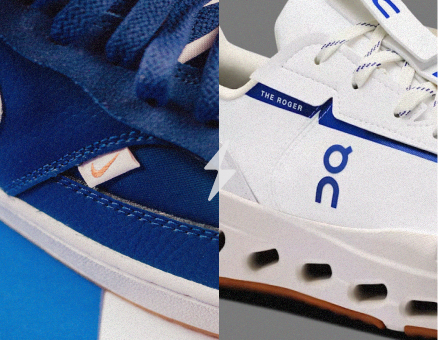
Two sportswear companies reported very different quarters this year. Nike’s sales fell 4% in the three months to August 2026, its sales in Greater China fell 26% once currency moves are taken out, and it expects revenue to fall by a high single-digit percentage this financial year. On, the Swiss running brand, grew sales by 21.6% on the same basis while keeping 65.4% of each sale as gross profit. On’s growth is slowing, and Yahoo Finance tied its refusal to discount to a sales miss in August this year.
What changed
Nike (NYSE: NKE) reported its first quarter of fiscal 2027, the three months to 31 August, on 1 October 2026. According to Nike’s results release, revenue was US$11.2 billion, down 4% on a reported basis and down 5% on a currency-neutral basis. Sales through Nike’s own stores and website fell 8% to US$4.1 billion. The gross margin, the share of each sale left after the cost of making the product, rose 60 basis points to 42.8%, which Nike put down mainly to lower warehousing and logistics costs.
The weakest region was Greater China. Sales there fell 26% on a constant-currency basis, or 22% as reported, Reuters reported, and have now fallen for nine quarters in a row. Reuters says China is about 15% of Nike’s annual revenue. North America, Nike’s biggest region, grew 2% on a constant-currency basis.
Nike also gave a forecast. It expects revenue to decline by a high single-digit percentage in fiscal 2027, the year to 31 May 2027. Analysts had, on average, expected a fall of about 2%, according to LSEG data cited by Reuters. Nike announced a new restructuring programme, called Pace, with job cuts whose number it does not yet know. Nike expects Pace to save about US$2.5 billion through fiscal 2031, with most of the savings in fiscal 2029 and 2030.
The next day, Friday 2 October, Nike’s shares fell in early trading to around their lowest level in 12 years, Reuters reported, far below a 2021 peak of about US$175. They closed down 3.6% at US$33.87, on market quote data. CNBC reported the shares had fallen more than 40% this year.
On (NYSE: ONON) last reported on 11 August, for the three months to 30 June. In its results filed with the US Securities and Exchange Commission, On reported net sales of 850.3 million Swiss francs, up 13.5% as reported and 21.6% on a constant-currency basis. Its gross margin was 65.4%, up 3.9 percentage points on a year earlier, even after absorbing higher US import tariffs.
Why it binds
The two companies sit on opposite sides of the same trade-off: price against volume.
On has chosen price. In its August this year results it said it does not compromise its full-price integrity for volume, even in a heavily promotional market. The cost showed up in sales. On missed analysts’ estimate of 878.16 million Swiss francs for the quarter, and growth in the Americas, which Reuters says is more than half of On’s revenue, slowed to 13% on a constant-currency basis from 17% in the first quarter. Reuters reported that On’s US-listed shares fell as much as 22% that day. Yahoo Finance reported that On stuck with its premium sales model instead of leaning into sales, and that this led to the miss. The benefit showed up in the margin. On raised its full-year gross margin forecast to at least 65%, from 64.5%.
Nike is working its way back from the other side. Analysts say Nike’s problems stem largely from too few compelling new products, which led to more promotions and discounts, according to Reuters. Chief executive Elliott Hill said on the results call that “we’ve been oversupplying our iconic retro product”, and Nike is cutting the number and frequency of retro sneaker launches after years of oversupply and discounting, Reuters reported. Hill also said Nike’s performance business, which includes running, “is not yet large enough to offset the pressure” in Nike Sportswear, Jordan Brand and Greater China.
Nike’s margin did rise, but Nike credits lower warehousing and logistics costs, not pricing. Its plan to protect price takes sales out first. In China, Reuters reported, Nike plans to pull online sales rights from some of its biggest retail partners from January, and Hill warned that near-term revenue and profitability there would take a hit.
On’s margin and Nike’s margin are both gross margins, measured the same way, from each company’s own results: about 65% at On and 42.8% at Nike. A gross margin is not profit after all costs.
Who absorbs it
At Nike, shareholders have carried the turnaround so far, with the shares down more than 40% this year on CNBC’s figures. Employees face job cuts under Pace, with notifications starting in 2027, Reuters reported. Retail partners in China lose some online sales rights from January. Hill has said stabilising China will take multiple seasons.
Nike has also faced competition for athlete endorsements from On, which has continued to expand its sponsored roster with high-profile sports talent. On plans its first football boots in 2027.
At On, the cost of holding price falls first on volume and on its wholesale partners. On says it is deliberately managing what it sells into wholesale to protect full-price integrity, and it expects third-quarter growth of around 17% on a constant-currency basis, slower than the 21.6% of the June quarter. Not everyone expects the margin to hold: Jefferies analyst Randal Konik warned that On’s margin gains may not be sustainable as growth moderates and inventory remains high, Reuters reported.
On is setting longer goals. At its 22 September investor day, On said it is aiming for high-teens constant-currency sales growth a year through 2029, a gross margin of at least 65% throughout, and its first share buyback, of up to US$1 billion through the end of 2029. These are On’s targets, not results. On also reiterated its 2026 forecast of constant-currency sales growth in the low 20% range.
Nike and On are both listed in New York. No ASX-listed company has a direct link to this story.
What to watch
Two dated events test whether each company’s approach is holding.
The first is On’s result for the September quarter. On has not yet announced the date. On expects constant-currency sales growth of around 17%.
If growth comes in at or above about 17% with the gross margin at or above 65%, On would be holding both its pace and its price as growth slows. If growth falls short of about 17% while the margin holds, full price would again be costing On volume, the same trade-off as August. If the margin also slips below 65%, the case for the full-price approach would look weaker.
One detail matters for reading the margin: On expects up to US$65 million of tariff refunds in the third quarter to lift its reported gross profit, and its 65% forecast excludes them, so the comparison is the margin without the refunds.
The second is Nike’s investor day on 16 and 17 November 2026, where analysts expect a clearer plan for restoring growth and profitability, according to Reuters. Hill said Nike would update its targets through the fiscal year, beginning in November.
The signal to read is Greater China. If Nike gives a sign that China sales, down 26% on a constant-currency basis in the latest quarter, are steadying, the high single-digit decline it expects for the year would have a clearer floor. If China keeps falling and the forecast is lowered, the turnaround would be taking longer than Nike has said so far.