If you’ve been waiting for what might be the biggest stock market launch in human history, your countdown clock just hit zero. Elon Musk’s SpaceX has officially pulled back the curtain, dropping its highly anticipated S-1 prospectus ahead of its Nasdaq debut (where it’s set to trade under the ticker symbol SPCX).
For nearly three decades, the company’s inner financial workings were locked away tighter than an Area 51 vault. But now that the books are open ahead of its expected 12th of June launch, we can see exactly how this projected $1.8 trillion behemoth makes—and loses—its money.
Key SpaceX IPO Details At a Glance
| IPO Parameter | Details & Specifications |
|---|---|
| Ticker Symbol | SPCX |
| Expected Listing Date | As early as June 12, 2026 (Roadshows begin early June) |
| Target Valuation | According to its publicly filed S-1 prospectus, SpaceX is targeting an initial public offering valuation range of $1.8 Trillion to $2 Trillion |
| Target Raise | $40 Billion to $80 Billion (Dwarfing Saudi Aramco’s $29 billion record) |
| Allocation | In a rare move, up to 30% of the float is being reserved for retail investors on the NASDAQ |
| Lead Underwriter | Goldman Sachs has secured the coveted “lead-left” position |
Company Revenue and Valuation
Outer-Space Multipliers
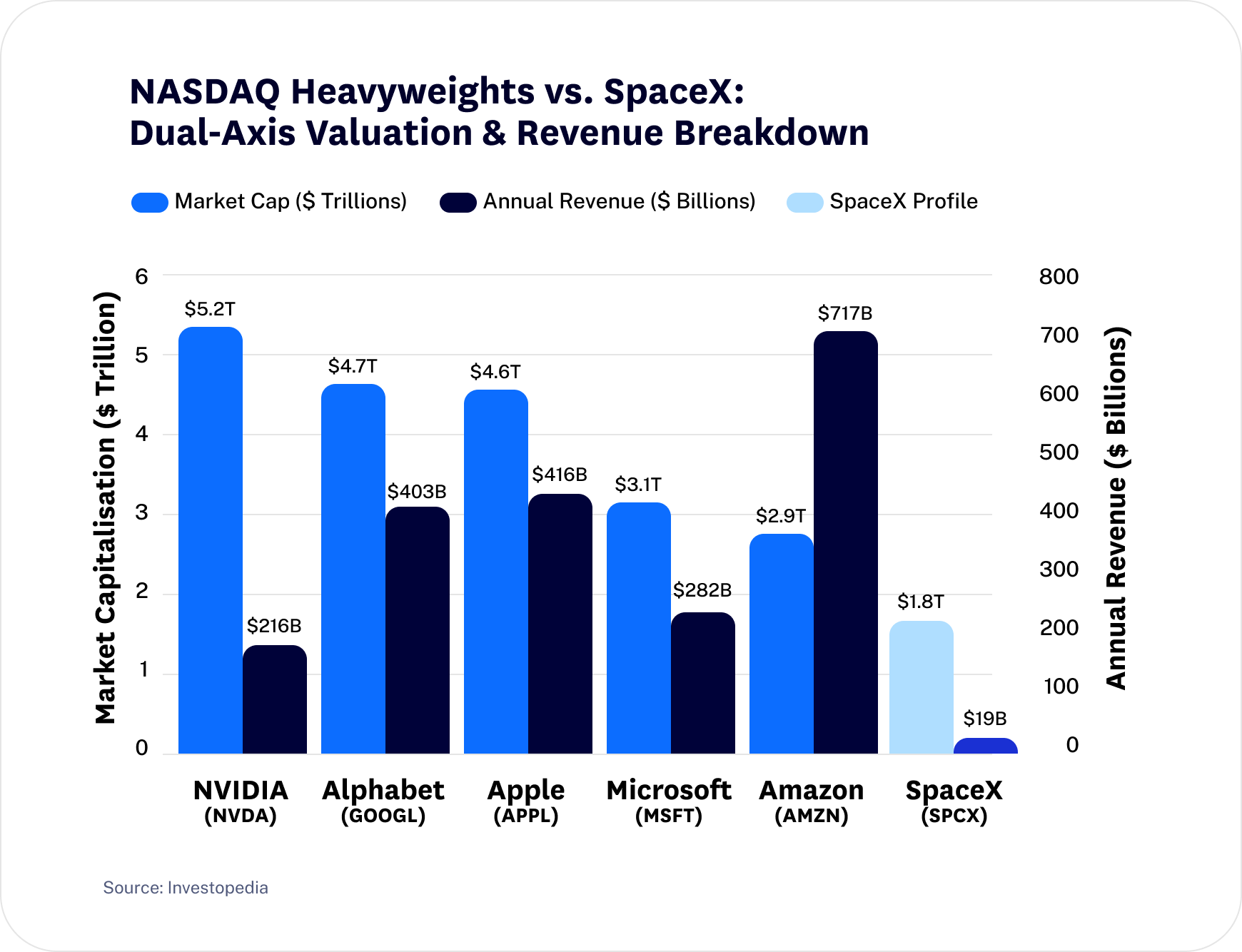
If NVIDIA’s valuation-to-revenue relationship seems stretched, SpaceX is operating in an entirely different atmosphere.
At a $1.8 trillion market cap compared to $19 billion in trailing revenue, SpaceX is launching onto the NASDAQ trading at a staggering multiple of roughly 95 times its annual sales.
To put that into perspective, highly profitable legacy tech champions like Apple and Microsoft trade at multiples between 10 to 12 times their revenue. Even NVIDIA, the poster child for the artificial intelligence boom, trades at roughly 24 times its revenue.
Mathematically, SpaceX is estimated to be arriving with a valuation multiplier that is quadruple the tech industry average.
About Company Divisions and Profitability
Top-line spoiler alert: SpaceX brought in $18.7 billion in consolidated revenue last year. The catch? It also recorded a staggering $4.9 billion net loss.
To understand why a company valued at over a trillion dollars is burning through cash like literal rocket fuel, you have to look past the headlines. SpaceX isn’t just a rocket company anymore; it’s a three-headed giant split into distinct divisions: Connectivity, Space, and AI.
Let’s lift the hood on each division to see who is bringing home the space-bacon and who is draining the tank.
1. Connectivity (Starlink)
If SpaceX has a star pupil, this is it. The Connectivity segment—which houses the Starlink satellite internet network—is the real financial engine of the entire operation.
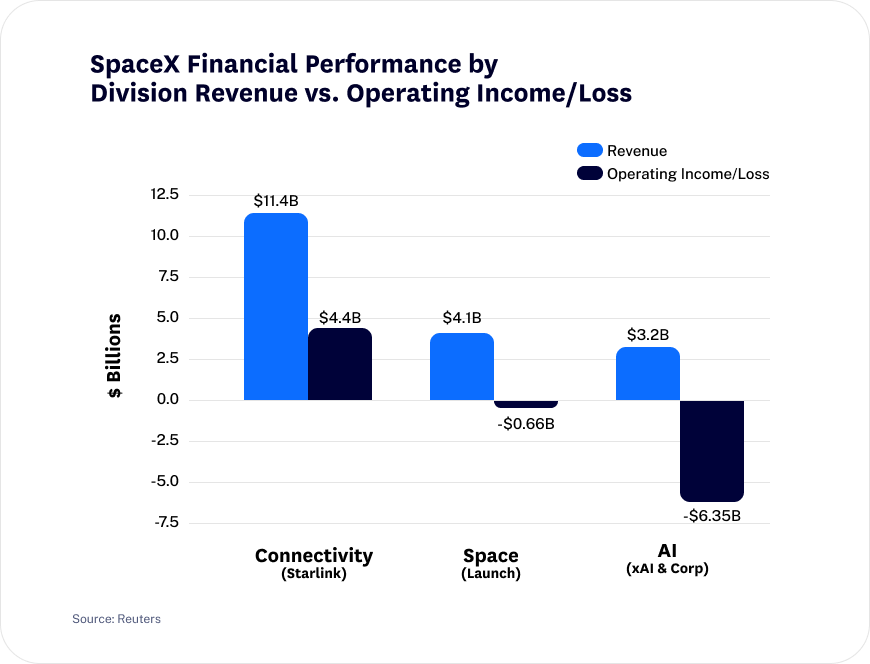
The Numbers: Starlink brought in $11.4 billion in revenue, accounting for nearly 70% of SpaceX’s total intake. Even better? It’s highly profitable, posting $4.4 billion in operating income (that’s profit from core business operations before taxes, interest, and accounting adjustments strip it away).
The Momentum: The growth isn’t slowing down. In the first three months of this year, Starlink generated over $3.2 billion. With more than 10 million active subscribers across 150+ countries and a constellation of roughly 10,000 satellites spinning overhead, Starlink is effectively funding Elon’s wilder intergalactic dreams.
2. Space (Falcon, Dragon, Starship)
This is the division everyone pictures when they think of SpaceX—heavy rockets, dramatic booster landings, and massive NASA contracts. But while it’s the most iconic branch of the tree, it’s currently operating in the red.
The Numbers: The launch business brought in $4.1 billion in revenue, but walked away with an operating loss of $657 million.
The Culprit: Why the loss? One word: Starship. SpaceX is pouring an astronomical amount of cash into researching and developing its next-generation megarocket. R&D swallowed a massive $3 billion, plus another $930 million in the first quarter of this year alone. Think of this segment as a long-term play; it’s burning cash today so it can completely dominate the commercial space transport industry tomorrow.
3. AI (xAI & X Corp)
Here is where things get a bit messy—and controversial. Following SpaceX’s acquisition of Musk’s artificial intelligence startup, xAI, the company created a brand new AI division that bundles xAI with the X social media platform. Right now, it’s acting like a financial supermassive black hole.
The Numbers: The AI segment generated $3.2 billion in revenue but suffered a jaw-dropping operating loss of $6.35 billion. The loss has only accelerated, causing an additional $2.5 billion in just the first three months on a meagre $818 million in revenue.
The Capex Beast: To build advanced AI models like Grok, you need massive data centres (like their “Colossus” facility) and truckloads of expensive microchips. That requires heavy Capex—short for capital expenditure, or the serious dough a company spends to buy and build physical, long-term assets. SpaceX funnelled a wild $12.7 billion of Capex into xAI, which accounted for over 60% of the entire company’s infrastructure spending.
The Pricing Factor You Can’t Ignore: The Elon Musk Effect
When analysing a valuation as high as 95 times trailing sales, traditional financial metrics only tell part of the story. To truly understand how SpaceX can command a $1.75 trillion to $2 trillion market cap, investors must factor in the “Elon Musk Effect”. This term describes Musk’s unique ability as a controlling shareholder to significantly alter market valuations and investor sentiment through his public commentary, political alignments, and corporate decisions. When evaluating how this intangible asset shapes the company’s financial profile, the effect presents a distinct set of structural advantages and corresponding risks.
The Tesla Precedent: How the Brand Brandishes the Balance Sheet
To understand how this psychological premium translates directly into hard corporate numbers, look no further than the historical precedent set by Tesla. In the fixed-income and debt markets, this phenomenon is often analysed as a “halo effect”—a corporate reputation so powerful that it allows a company to raise massive amounts of capital on highly favourable terms, even when the underlying financial fundamentals suggest severe risk.
During the critical production ramp-up of the mass-market Model 3, Tesla successfully raised $1.5 billion in debt capital while locking in a remarkably low interest rate of just 5%. Under standard market conditions, securing debt at this rate would be nearly impossible for a business in Tesla’s financial position at the time. The company had just burned through a record $1.16 billion in cash in a single quarter, and Moody’s had officially downgraded Tesla’s bonds to a B3 credit rating—six notches deep into “junk” territory.
The Tesla experience demonstrates that the halo effect effectively causes investors to “suspend reality”. Rather than focusing on immediate credit risks and immense cash burn, debt and equity buyers chose to overlook the balance sheet liabilities in favour of Musk’s ambitious long-term production targets. This brand loyalty allowed Tesla to successfully tap into public equity markets eight separate times over a seven-year period to sustain its operations.
For SpaceX, this capability is highly relevant. As the company navigates an expensive, capital-heavy transition into space-based AI data centres and next-generation rocket development, the ability to open cheap, highly favourable capital pipelines ensures the business can fund its heavy operational expenses. However, it also creates an environment reminiscent of dot-com era euphoria. Public investors must remain aware that they are funding a highly complex, capital-intensive technology business at a premium price, where the premium relies heavily on maintaining the market’s absolute confidence in the founder’s execution.
Corporate Governance & Retail Investor Risks
How does SpaceX’s dual-class share structure work, and how much equity and voting control does Elon Musk retain?
When you buy shares in a public company, you usually expect two distinct things for your money: a slice of the financial pie (equity) and a meaningful say in how the company is run (voting rights). While utilising multiple share classes is a well-established practice heavily popularised by Silicon Valley giants like Alphabet and Meta, the upcoming SpaceX IPO deploys this familiar strategy with particularly aggressive intensity.
If you are planning to invest in SpaceX when it hits the Nasdaq, you need to understand that you are buying economic exposure, not a seat at the leadership table.
Here is exactly how SpaceX’s dual-class share structure works and how much control Elon Musk is keeping for himself.
The Class A vs. Class B Split
SpaceX’s S-1 prospectus outlines a dual-class share structure, a setup popular among silicon valley tech giants but deployed here with aggressive intensity. The company’s equity is split into two distinct tiers:
| Class A Shares (The Public Tier) | Class B Shares (The Super-Voting Tier) |
|---|---|
| These are the shares that retail and institutional investors will buy during the IPO under the ticker SPCX. They carry the standard one vote per share. | These are the insider shares held by Elon Musk and early back-room investors. They are “super-voting” shares, meaning each single share carries 10 votes. |
Elon Musk’s Grip on the Wheel: The 42/79 Split
Because of the math behind those 10-to-1 super-voting shares, there is a massive disconnect between who owns the company’s financial value and who actually calls the shots.
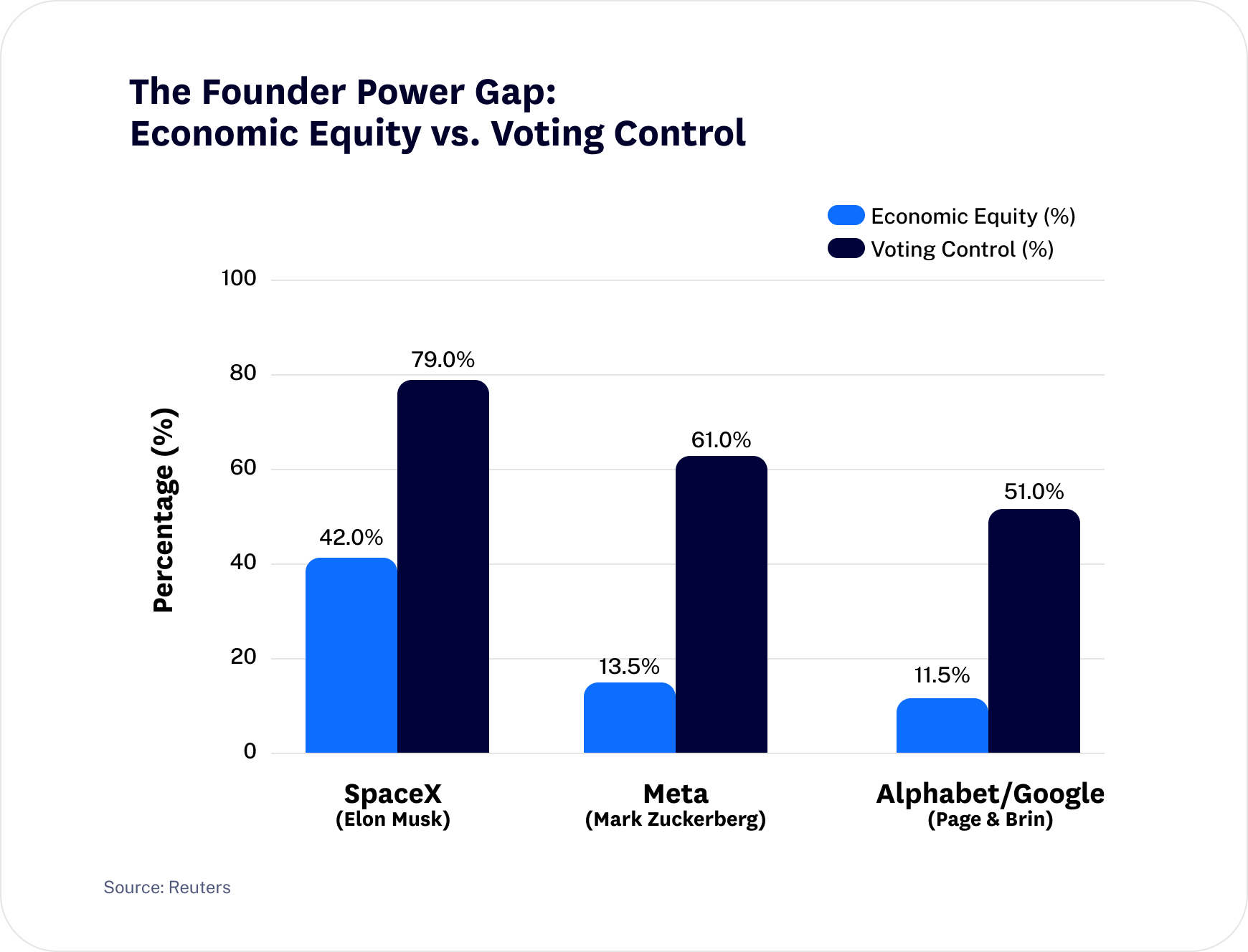
- His Equity Stake: Elon Musk owns approximately 42% of SpaceX’s total equity. That is his actual financial ownership of the $1.75 trillion to $2 trillion business.
- His Voting Control: Because of his heavy concentration of Class B shares, Musk commands roughly 79% of the total voting power.
To put that in perspective, Musk’s control over SpaceX is even tighter than Mark Zuckerberg’s control over Meta or Larry Page and Sergey Brin’s grip on Alphabet. Even though incoming public investors are injecting a historic $75 billion to $80 billion of fresh capital into the business, they will collectively hold almost no sway over the company’s trajectory.
What This Means for Retail Investors
In a traditional company, if a CEO makes a wild decision—like spending billions of dollars on an AI side-project or waiving the insider lock-up period so early investors can dump stock immediately—the shareholders can use their votes to push back, alter executive pay, or reshuffle the board of directors.
At SpaceX, that primary enforcement mechanism is functionally neutralised. Because Musk owns 79% of the votes, he acts as the CEO, CTO, and Board Chair with absolute authority.
What are the risks of SpaceX potentially waiving the standard 180-day lock-up period for insiders?
When a private company finally decides to list on a public stock exchange, there is a standard safety feature built into almost every deal to protect new retail investors. It is called a lock-up period.
But according to the recent S-1 prospectus details and corporate legal analysis, SpaceX is considering doing something incredibly rare and highly controversial: waiving that rule entirely.
To understand why this is sending shivers down the spines of market analysts, you first need to understand how the standard IPO playbook works, and why breaking it creates a highly volatile environment for everyday investors.
What is a Standard Lock-Up Period?
Think of an IPO lock-up period as the financial world’s version of a commitment guarantee. Normally, when a company goes public, early insiders—think company founders, executives, venture capitalists, and long-term employees—are legally banned from selling any of their shares for a set timeframe, usually 180 days (about six months).
This rule exists for two very practical reasons, such as Price Stability and Alignment of Interests, forcing the people who know the company best to stay in the foxhole with the new public investors during the highly volatile initial months of trading. It proves they are focused on long-term growth, not a quick payday.
By potentially waiving this 180-day rule, SpaceX would allow its insiders to sell their shares on the open market immediately upon listing.
Alternative Investment Vehicles
Are there investment alternatives (like ETFs or private equity) if investors miss the IPO?
Missing the absolute first day of a heavily oversubscribed IPO is a common experience for retail investors, as institutional giants tend to secure the front of the queue. However, missing the initial float does not lock investors out of the space race entirely. Gaining economic exposure remains completely accessible through standard U.S. market pathways after the listing goes live.
Here is how you can pivot using the direct U.S. market or the pre-IPO side door.
1. The Direct U.S. Market Route (Buying Post-Listing)
The most straightforward option is simply waiting for the stock to officially start open trading on the Nasdaq under the ticker SPCX.
The moment the opening bell rings and the stock goes live to the public, it becomes fair game for anyone with access to the U.S. share market. However, day-one trading for a multi-trillion-dollar tech giant is bound to be a wild ride.
2. The Pre-IPO Side Door (U.S. Listed Funds)
What if you do not want to wait for the official mid-June listing, or you want a way to buffer the extreme volatility of day-one trading? You can actually buy into SpaceX right now through a clever secondary market side door: U.S.-listed closed-end funds.
Because SpaceX has been a private titan for over twenty years, a few specialised, publicly traded venture funds have already bought up massive private blocks of Elon Musk’s company. You can buy shares in these funds on the U.S. market exactly like a normal stock, instantly inheriting a slice of their pre-IPO SpaceX holdings:
- Destiny Tech100 (NYSE: DXYZ): This is a publicly traded closed-end fund specifically designed to give everyday investors access to private tech unicorns. SpaceX is the absolute anchor tenant of this fund, making up roughly 23.3% of the entire portfolio alongside other major tech players like OpenAI.
- ARK Venture Fund (ARKVW): Managed by Cathie Wood’s team, this vehicle allows retail participants to capture private asset growth, holding a prominent 7.43% allocation wrapped up directly in SpaceX equity.
- NDQ: This ETF tracks the top 100 companies listed on the Nasdaq. Because SpaceX is debuting with instant mega-cap status, the underlying index will automatically buy blocks of the stock during its next scheduled rebalancing cycle.
How to Buy Shares in SpaceX in Australia
Once the countdown hits zero and SpaceX officially clears its Nasdaq debut under the ticker symbol SPCX, buying SpaceX shares from Australia is a straightforward process. You don’t need a specialised international broker or an institutional connection to get a piece of the action. At Superhero, we offer direct investment in U.S. shares through a low-cost, easy-to-use platform, allowing you to invest in global companies seamlessly. If you choose to invest:
Step 1: Log In and Set Up Your Account
First things first, log into your Superhero account. If you are new to the platform, setting up an account takes just a few minutes. You’ll want to make sure your profile is fully verified and ready to trade well before the U.S. opening bell rings.
Step 2: Fund Your Wallet and Convert to USD
To buy U.S. stocks, you need U.S. dollars. Unlike traditional platforms that force you to wait days for international bank transfers to clear, you can load your Superhero wallet with Australian dollars instantly using local funding features like PayID. Once your AUD hits your account, you can transfer your Australian dollars to U.S. dollars within your wallet in real time. Having your capital converted into greenbacks ahead of time ensures you won’t be caught flat-footed when the market opens.
Note: Foreign exchange fees apply.
Step 3: Search for the Ticker Symbol
Head over to the Invest tab and use the search bar to track down the asset. You can search directly for SpaceX or use its official Nasdaq ticker symbol, SPCX.
Step 4: Choose Your Order Type and Place Your Trade
Click on the SpaceX stock profile to open the order screen.
Step 5: Keep an Eye on the Clock
The U.S. stock market opens at 11:30pm AEST (or 10:30pm AEST depending on daylight savings).
Frequently Asked Questions
Is SpaceX the only space stock?
No. There are a number of popular space stocks such as Rocket Lab (RKLB), AST SpaceMobile (ASTS) and a number of ETFs such as the BetaShares Space Industry ETF (RCKT) and iShares US Aerospace and Defense ETF (ITA).
You can check out these and more in our dedicated Space Category on Superhero.
When will SpaceX be added to index ETFs?
Under current Nasdaq rules, a company that has newly listed must wait up to 12 months before becoming eligible to be added to major indexes such as the Nasdaq 100.
However, in this instance, Nasdaq has proposed a ‘Fast Entry’ rule allowing a newly listed company to join the index in less than 1 month, provided it has a high enough market capitalisation that ranks among the Top 40 members of that index.
Given the size of this IPO, SpaceX will be eligible for that Fast Entry inclusion and therefore we expect it to join the Nasdaq 100 (and subsequently appear in index ETFs) within that much reduced time limit.
Which other large companies will list this year?
SpaceX is anticipated to not be the only large company listing this year with OpenAI and Anthropic also considering going public in 2026. Check out our curated list of the Top 10 Upcoming IPOs for more information.