

November 28, 2025
Google’s Gemini 3 Steals AI Crown 👑
Google's Gemini 3 sparks record rally as Alphabet gains $1 trillion in market value. Meanwhile, Oracle crashes 30% on debt fears and Dell beats on AI server demand. Plus: Helloworld bids for Webjet.


Scan this article:
Hey Superheroes,
This week’s major economic headline came from the US, where consumer spending from September showed demand softening. Retail sales and consumer confidence readings both came in weaker than expected, a sign that Americans are pulling back after a long period of resilient demand.
Softer consumer data boosted expectations that the Federal Reserve could cut interest rates at its December meeting. Lower expected rates immediately lifted US equities, with the S&P 500, Dow and Nasdaq all ending the week in green. Rate-sensitive sectors like homebuilders, retailers and parts of tech benefited most.
Back home, the ASX 200 recovered from the previous week’s lows, bouncing back to the 8,600 zone. Financials remained under pressure, reflecting sensitivity to the domestic rate outlook, while the RBA has kept the cash rate on hold as inflation readings continue to come in hotter than the central bank’s target range, with experts now saying a rate rise looks likely in 2026.
Let’s dive into this week’s biggest stories.
Google’s Gemini Moment
Alphabet (NASDAQ: GOOGL) kicked off the week with its sharpest rally in months, surging over 6% on Monday and adding another 4% in pre-market trading, pushing the stock to fresh record highs above US$318.
The momentum quickly spilled over into other AI-linked names with Broadcom, Micron and AMD advancing up to 11%. This sudden resurgence set the tone for a broader rotation back into AI stocks.
🤖 Gemini 3 changes the game
Fuelling the rally is Google’s latest Gemini 3 model, which launched last week to widespread Silicon Valley praise. According to Bloomberg, Gemini 3 Pro offers improved reasoning, stronger multimodal capabilities and better agent-like workflows with material gains over the previous generation in visual understanding, coding and academic problem-solving.
What truly shifted sentiment was Google’s decision to integrate Gemini directly into Search at launch. Analysts view this as a meaningful step towards embedding AI into Alphabet’s core revenue engine and positioning the company to monetise AI more directly across advertising, productivity and cloud workloads.
Even Salesforce CEO Marc Benioff weighed in, saying in a Sunday social media post that “It feels like the world just changed, again” about his first hours using Gemini 3 after years of using OpenAI’s ChatGPT.
💰 The numbers are staggering
Alphabet has gained roughly US$1 trillion in market value since mid-October. As of Monday’s close, the company sits at around US$3.8 trillion in market capitalisation, now only US$700 billion behind Nvidia’s US$4.4 trillion valuation.
The company also eclipsed US$100 billion in revenue in a single quarter for the first time when it reported third-quarter results late last month. Weeks later, Warren Buffett’s Berkshire Hathaway revealed it had taken a new position in Alphabet worth more than US$4.3 billion at the end of September.
⚡ TPUs take on Nvidia
The other major driver is growing confidence in Alphabet’s tensor processing units (TPUs). A report by The Information stated that Meta is in early discussions to use Google’s TPUs in its data centres by 2027 and may even rent TPU capacity through Google Cloud as early as next year.
If this moves ahead, it would mark one of the first large-scale deployments of a non-Nvidia AI accelerator by a major tech company. That development has market-wide implications – Google Cloud gains leverage in enterprise AI infrastructure, Nvidia’s dominance faces a credible challenger, and chip partners like Broadcom experience stronger demand.
This shift gives Alphabet a strategic advantage across hardware, software and cloud.
Oracle’s Debt Trap
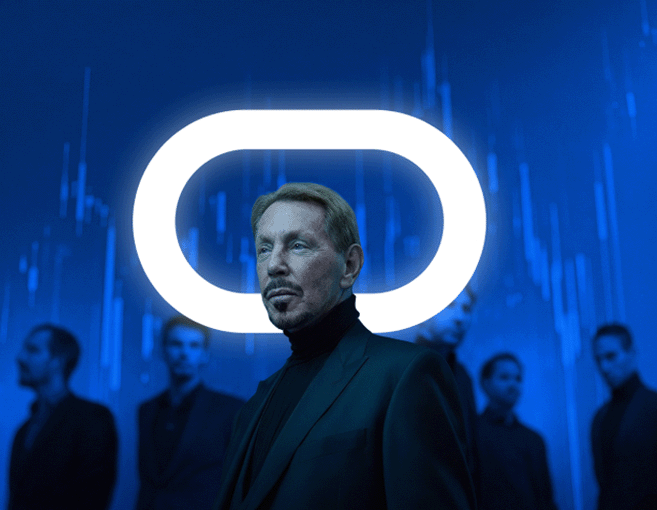
While Google soared, Oracle (NASDAQ: ORCL) became a focal point for investors concerned about AI bubble fears.
The database giant’s stock has plunged roughly 30% in the last month, falling from September peaks near US$345 to around US$200 as investors grow increasingly concerned about the company’s massive debt-fuelled AI infrastructure buildout.
📉 The debt spiral
Oracle’s debt load has ballooned to around US$95-100 billion after an US$18 billion bond sale, with estimates suggesting it could reach US$290 billion by 2028 if all planned AI data centres are built. The company raised another US$18 billion through a project loan in New Mexico and is linked to a US$38 billion loan package tied to sites in Texas and Wisconsin.
To fund this massive expansion, Oracle’s free cash flow turned negative at approximately -US$5.9 billion, the weakest it has been in decades. The company’s debt-to-equity ratio now sits well above industry norms, putting pressure on both shareholders and bondholders.
⚠️ Credit markets flash warning
Morgan Stanley analysts Lindsay Tyler and David Hamburger warned this week that the cost to insure Oracle’s debt, measured through five-year credit default swaps, climbed to 1.25 percentage points in November. They said this level could soon move above 1.5 points and possibly approach 2 points next year if Oracle doesn’t provide clearer details on how it plans to fund its AI expansion.
That would put risk levels close to those seen during the 2008 financial crisis, when Oracle’s CDS last peaked.
Barclays analyst Andrew Keches recently downgraded Oracle’s debt, stating bluntly: “We struggle to see an avenue for ORCL’s credit trajectory to improve.”
🎰 The OpenAI bet
Oracle’s entire 2025 story has been dominated by its US$300 billion cloud compute contract with OpenAI, announced in September. The deal initially sent shares soaring 36% in a single session, but the euphoria quickly reversed as analysts scrutinised the financing requirements.
Around 58% of Oracle’s future order backlog is reportedly tied solely to OpenAI, raising massive client concentration risk. Capital spending is projected to hit US$35 billion in fiscal 2026, up from US$21 billion in fiscal 2025, with free cash flow expected to remain negative for five consecutive years.
All eyes are now on Oracle’s earnings call on 15 December, when investors will look for a clear plan on how the company will fund its AI buildout and data centre pipeline.
🔦 Some other things we’re shining the Spotlight on:
DELL RISES ON AI SERVER DEMAND: Dell Technologies (NASDAQ: DELL) reported non-GAAP earnings of US$2.59 per share in Q3, beating estimates by 4.44%. Revenues rose 11% year-on-year to US$27.01 billion, driven by record AI server shipments. The company shipped US$5.6 billion worth of AI servers in the quarter with a healthy backlog of US$18.4 billion. Shares gained 4.53% in pre-market trading.
HELLOWORLD BIDS FOR WEBJET: Helloworld has lobbed a A$353 million takeover offer for online travel agent Webjet in a deal that would boost its digital presence. Webjet’s board has agreed to grant Helloworld due diligence to firm up its offer of 90¢ a share. Webjet’s shares surged almost 17% on the news to 88¢.
DRONESHIELD RECOVERS FROM CEO SELLOFF: DroneShield (ASX: DRO) bounced back this week after a A$50 million CEO share sale caused the market to panic.
Keep up to date on the markets by following us on Instagram @superheroau.

Become a part of
our investor community
Why you should join us:
- Join free and invest with no monthly account fees.
- Fund your account in real time with PayID.
- Get investing with brokerage from $2. Other fees may apply for U.S. shares.
Read our latest articles
Make knowledge your superpower and up your skills and know-how with our news, educational tools and resources.