Hey Superheroes,
Markets had one clear focus this week. Oil.
The conflict involving Iran has pushed Brent crude above US$100 a barrel for the first time since the 2022 energy shock. And the ripple effects are already being felt here in Australia.
The International Energy Agency responded with a record release of 400 million barrels from emergency reserves. It’s the largest coordinated oil drawdown in the agency’s 50 year history. Even so, markets weren’t convinced. Traders largely shrugged it off as too small to fill the supply gap created by the near shutdown of the Strait of Hormuz. It is only equivalent to 20 days worth of oil that passes through there each day.
Meanwhile, US February CPI held steady at 2.4%. Normally that would move markets. This week it barely registered. Right now oil is the inflation story everyone is watching, and it’s quietly pushing expectations for US rate cuts further out.
Closer to home, the RBA meets next week as Australian consumer inflation expectations rose to 5.2% amid higher fuel costs.The current rate is 3.85%.
Here’s what’s moving markets this week.
The $100 oil shock hitting closer to home than you think
Australia woke up this week to a fuel risk that suddenly feels very real.
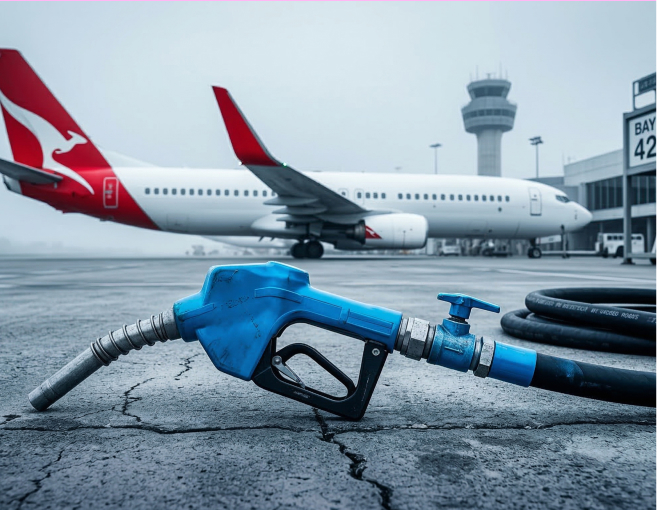
Sydney Airport CEO Scott Charlton warned there are no guarantees Australia will receive aviation fuel after this month.
Sydney Airport alone handles about 40% of the country’s aviation fuel supply. That’s roughly 9 million litres every day. New South Wales also has no local refining capacity, so the state relies entirely on imported fuel.
Right now, supply for April is uncertain.
⛽ How we got here
The disruption traces back to the Strait of Hormuz. It is a narrow shipping route that carries about one fifth of the world’s oil supply.
Since Israeli and US strikes on Iran late last month, shipping traffic through the strait has slowed dramatically.
This week, three oil tankers were struck overnight in the waterway. Oil prices jumped more than 8% in a single trading session and Brent crude pushed past US$100 a barrel.
For context, oil was sitting around US$72 before the strikes began.
To stabilise supply, the IEA’s 32 member nations agreed to release 400 million barrels from strategic reserves. That is more than double the release triggered by Russia’s invasion of Ukraine.
The United States alone is contributing 172 million barrels.
Even so, analysts at MST Marquee estimate the release may only cover around a quarter of the supply gap created by the disruption. Markets are already pricing in the rest.
🛢️ Australia’s uncomfortable reality
This situation has also highlighted a vulnerability closer to home.
As of December, Australia held about 50 days of oil imports onshore. That makes it the only IEA member nation not meeting the treaty requirement of 90 days of supply.
Resources Minister Madeleine King says building reserves to that level could cost around $20 billion. Critics argue it is a necessary investment, especially when smaller markets like New Zealand maintain about 95 days of coverage.
To help boost short term supply, Energy Minister Chris Bowen announced a temporary change to fuel standards.
Ampol will be allowed to blend higher sulphur fuel into Australia’s domestic supply for the next 60 days. Normally that fuel would be exported.
The change could add about 100 million litres a month to local supply.
It helps, but it is clearly a short term fix.
✈️ What this means for investors
The impact is already spreading.
Air New Zealand has cut 1,100 domestic flights due to rising fuel costs. Qantas is lifting fares and exploring up to $1 billion in long term debt to manage higher expenses. Analysts are also flagging potential capacity cuts if supply tightens further in April.
Virgin Australia has not said whether it may reduce flights.
For investors, the exposure goes well beyond airlines. Logistics companies, agriculture and businesses that rely heavily on imports could all feel the pressure.
On the other side of the trade, some sectors may benefit. Current market data shows increased demand for energy producers, fertiliser manufacturers, and infrastructure operators with onshore storage capacity. US urea prices jumped 30% in a week as supply disruptions threatened fertiliser shipments ahead of spring planting.
The bigger picture is that this may take time to resolve.
As MST Marquee’s analyst put it, the scale of the IEA’s reserve release suggests policymakers do not expect the conflict to end quickly. And when those reserves are eventually refilled, that could keep oil prices under pressure for longer.
🔦 Some other things we’re shining the Spotlight on:
ATLASSIAN CUTS 1,600 JOBS: Australia’s software giant (NASDAQ:TEAM) is trimming 10% of its global workforce, including about 480 roles in Australia. CEO Mike Cannon-Brookes says the restructure will fund a bigger push into AI, including Atlassian’s new platform Rovo and expanded enterprise sales. The shift reflects a bigger challenge. Atlassian’s per-seat model for tools like Jira and Confluence faces pressure as AI agents start doing work that once required human users. The market has noticed. Shares are down about 50% this year and nearly 80% from their 2021 peak of $US458. The AI revolution is now eating its own.
TPG EYES AN EXIT FROM FUNLAB: Private equity firm TPG is preparing to sell Funlab, the company behind Strike Bowling and Holey Moley. After backing the business during the pandemic, the investment has paid off as experiential entertainment bounced back strongly. UBS has been appointed to run a sale process expected to start later this year. For TPG, it could be a strategic window to cash in.
REVOLUT FINALLY GETS ITS UK BANKING LICENCE: After five years of waiting, Revolut is now a fully licensed bank in the UK. The fintech, valued at US$75 billion and backed by Nvidia, can now offer full lending products and deposit protection of up to £120,000 under the UK’s Financial Services Compensation Scheme. CEO Nik Storonsky says a US banking licence is next. For traditional banks, the competition from a fully regulated digital player just got stronger.
Keep up to date on the markets by following us on Instagram @superheroau.