

May 14, 2026
Everything you need to know about Apple in 2026: AI, Ecosystem and iPhone Growth
Apple in 2026 isn’t trying to win the AI race by sprinting. It’s playing the long game. Watch, wait, then move with precision. In 2026, that strategy is starting to take shape. With Apple Intelligence powered by Gemini, a strong iPhone-17 cycle, the launch of the lower-cost MacBook Neo and John Ternus set to succeed…


Scan this article:
Apple in 2026 isn’t trying to win the AI race by sprinting. It’s playing the long game. Watch, wait, then move with precision.
In 2026, that strategy is starting to take shape.
With Apple Intelligence powered by Gemini, a strong iPhone-17 cycle, the launch of the lower-cost MacBook Neo and John Ternus set to succeed Tim Cook as CEO in September, Apple looks less like it’s chasing the AI wave and more like it’s steadily tightening control of its ecosystem.
This isn’t about a single breakthrough moment. It’s about stacking small, deliberate advantages that compound over time.
Apple Intelligence and Gemini: Closing the Gap, Not Chasing Hype
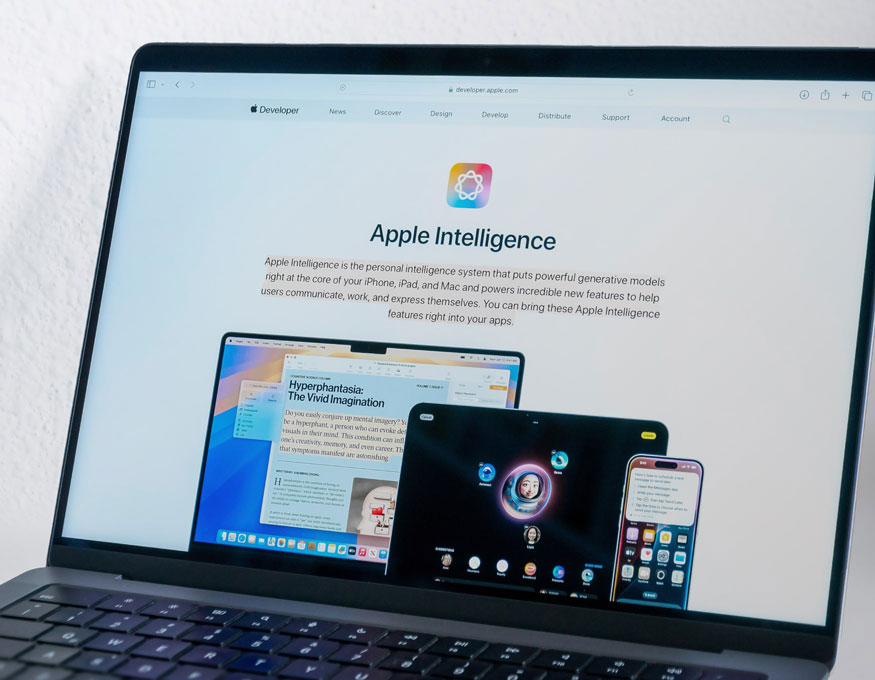
Apple’s partnership with Google to power Apple Intelligence and the next generation of Siri isn’t designed to drive immediate monetisation. It’s about accelerating capability, reshaping perception and maintaining control of the user experience.
At roughly US$1 billion a year for Gemini models and supporting infrastructure, the spend is meaningful in isolation. In Apple’s context, it’s modest, particularly against quarterly revenues exceeding US$140 billion.
The real value sits in what that investment unlocks.
Rather than rebuilding large-scale AI systems internally, Apple gains speed. It can deliver a more capable, context-aware assistant sooner, while reducing execution risk.
For investors, the implication is nuanced but important. AI doesn’t suddenly become a primary earnings driver. Instead, it begins to shift how the market views Apple’s role in the AI ecosystem.
If Apple successfully layers AI across its ~2.5 billion active devices, the benefits are likely to show up through stronger services engagement, higher perceived ecosystem value and over time, some expansion in valuation multiples.
Some analysts frame this as $50–$100+ per share in long-term fair value upside. Not immediate and not without execution risk, but meaningful if delivered.
The key point remains: Apple isn’t positioning itself as the AI pioneer. It’s positioning as the AI orchestrator, using best-in-class models to enhance and extend its existing ecosystem.
iPhone 17 Sales and Revenue: Apple’s Real Growth Engine in 2026
While AI continues to dominate the narrative, the iPhone remains the primary earnings engine.
Early estimates for fiscal Q1 2026 suggest iPhone revenue in the range of US$78–80 billion, representing roughly 12% year-on-year growth. Unit growth appears even stronger, supported by a large installed base of around 315 million upgrade-ready devices, a favourable Pro-model mix and a more normalised replacement cycle.
AI is contributing, but it is not yet the defining factor.
At this stage, it functions as a tailwind rather than a driver, adding an estimated 1–3 percentage points to unit growth and a similar low-single-digit uplift to revenue. Helpful, but not transformative.
The more meaningful impact sits further out.
By 2027, as AI features transition from incremental to essential, upgrade cycles could tighten, premium pricing may prove more resilient and Apple’s services layer has greater scope to expand.
For now, the picture is straightforward. The iPhone cycle is doing the heavy lifting, with AI enhancing the experience in the background.
A modest recovery in China, alongside improving demand across emerging markets, is also helping to stabilise both volumes and average selling prices.
Apple’s AI Strategy: Late, Then Better
Apple’s approach follows a familiar pattern.
It rarely leads the first wave. But when it enters, the product tends to be more refined, more integrated and more difficult for users to move away from.
This pattern has played out across smartphones, wearables and wireless audio. The strategy is consistent: allow the market to mature, then enter with a more cohesive and scalable experience.
AI appears to be following the same trajectory.
Siri has lagged competitors in recent years and that gap contributed to Apple missing the initial AI-driven re-rating seen across parts of the sector.
Rather than rushing to close that gap internally, Apple is taking a more measured approach. It is leveraging mature external models, prioritising privacy and system-level integration and embedding AI into products users already rely on.
It’s a deliberate trade-off. Early complexity and cost are absorbed elsewhere, allowing Apple to focus on delivery and user experience.
This doesn’t remove risk, but it reframes it. The challenge shifts from invention to execution.
MacBook Neo ($599): Apple’s Cheapest Laptop Expands the Ecosystem
While the iPhone strengthens the core, the MacBook Neo represents a strategic move to broaden the entry point.
At around US$599 (or A$899), it is Apple’s most accessible laptop to date. With 8GB of memory, 256GB of storage and an A18 Pro chip, it is clearly targeted at students and more price-sensitive buyers.
Positioned well below the MacBook Air, and in some cases below higher-end iPhone configurations, the Neo materially lowers the barrier to entry into the Apple ecosystem.
That’s the real story.
This is not simply a lower-priced device. It is an acquisition tool.
As users enter the ecosystem earlier, the long-term economics shift. Services, including the App Store, Apple Music and iCloud, become the centre of gravity. These are also Apple’s highest-margin revenue streams.
In that sense, the Neo is less about near-term hardware margin and more about long-term ecosystem expansion. It widens the funnel and increases the base of users who can be monetised over time.
Apple Stock Outlook 2026–2028: A Steady Compounder Thesis
When viewed together, Apple’s next phase doesn’t hinge on a single inflection point. It is a sequence of reinforcing steps.
In 2026, momentum is already established. The iPhone-17 cycle is driving growth, supported by a large and active upgrade base. AI is present, but largely in the background, contributing incremental improvements rather than reshaping demand. At the same time, the MacBook Neo expands the ecosystem from the lower end, bringing in new cohorts of users.
This foundation is important because it enables what follows.
As the cycle progresses into 2027 and 2028, AI becomes more visible. Apple Intelligence matures, Siri becomes more capable and services become more deeply embedded in everyday usage.
This is where the model begins to shift.
Not through a single defining AI product, but through accumulation. Intelligence becomes embedded across devices and services, improving usability at the margin and reinforcing ecosystem stickiness.
That is where the longer-term upside sits.
From a valuation perspective, the market is not fully pricing this trajectory. As of early 2026, Apple trades at a mid-teens forward P/E, reflecting a strong hardware cycle and some AI optionality, but not a full AI-driven re-rating. Consensus price targets suggest moderate upside, contingent on execution.
The pathway is clear, but not without risk. The Gemini partnership reduces early-stage AI uncertainty, while lower-cost devices expand the addressable ecosystem. Services remain the key monetisation lever, converting engagement into recurring revenue.
But the path isn’t frictionless. Execution will matter, particularly when it comes to AI quality and the evolution of Siri.
At the same time, Apple enters this phase with a structural advantage. Under John Ternus, its strength in hardware, from M-series Macs to AirPods and now extending to products like the MacBook Neo and iPhone Air, positions the company to integrate AI more seamlessly across devices as the 2027–2028 ramp unfolds.
That said, capability alone isn’t enough. If the user experience doesn’t feel meaningfully better, momentum can fade quickly.
Monetisation adds another layer of complexity. Apple will need to introduce AI-driven revenue in a way that feels natural, not gated or fragmented. Get that balance wrong and it risks eroding the very ecosystem it’s trying to strengthen.
At the same time, expanding into lower-cost devices helps grow the user base, but it also introduces pressure on margins. That trade-off only works if services growth scales alongside it.
In short, the opportunity is clear, but so is the execution bar.
Even without a material AI-driven re-rating, Apple’s ongoing share buybacks and growing dividend provide structural support to earnings per share, reinforcing its profile as a long-term compounder.
From narrative to numbers: a 2025–2028 sketch
Below is a simplified, directional view of how the iPhone-17 cycle, AI-driven engagement and Neo-led ecosystem expansion could flow through the model if the thesis plays out broadly as expected. *
| Metric (directional) | 2026E (Base) | 2027E (AI‑inflected) | 2028E (Steady‑state AI) |
| iPhone revenue (Q1 est.) | ~$78–80B | Low‑single‑digit growth driven by AI‑driven upgrade | Further upgrades from AI‑embedded services |
| iPhone unit growth contribution | 1–3% from AI | 3–5% | 2–4% |
| Services margin | ~70%–72% | ~72%–74% | ~74%+ |
| Forward P/E (non‑AI‑rerated) | ~15–16x | ~16–17x | ~17–18x |
These figures are illustrative rather than precise forecasts, but they highlight how incremental, AI-driven improvements can translate into measurable earnings and valuation effects over time.
The Bottom Line
Apple isn’t playing the same AI game as Alphabet, Meta or Microsoft. Those companies are focused on monetising AI directly through advertising, content or enterprise platforms.
Apple’s advantage lies elsewhere. It sits in the tight integration between hardware, operating system and high-margin services, supported by a privacy-first approach that can be both a strength and a constraint relative to more data-rich peers.
In that context, AI is not the product. It is the layer that makes the ecosystem more seamless, more valuable and more difficult to leave.
If that strategy holds, the outcome is unlikely to be a sharp re-rating. It is more likely to be something quieter, but potentially more durable: steady, long-term compounding.
With John Ternus, a hardware veteran with deep ecosystem experience stepping into the role in September 2026, Apple’s long-term execution looks well supported.
Frequently Asked Questions
Who is replacing Tim Cook as Apple CEO?
John Ternus is set to succeed Tim Cook as Apple CEO in September 2026. Ternus is a hardware veteran with deep ecosystem experience, and his appointment could position Apple to integrate AI more seamlessly across its device lineup, from M-series Macs to AirPods, the iPhone Air and the new MacBook Neo.
How much does the MacBook Neo cost?
The MacBook Neo is priced at around US$599 (or A$899), making it Apple’s most accessible laptop to date. It comes with 8GB of memory, 256GB of storage and an A18 Pro chip, and is clearly targeted at students and more price-sensitive buyers. Positioned well below the MacBook Air, the Neo is less about hardware margin and more about widening the funnel into Apple’s high-margin services ecosystem.
Is Apple using Google Gemini for AI?
Yes. Apple has partnered with Google to power Apple Intelligence and the next generation of Siri using Gemini models. The spend is roughly US$1 billion a year, which is meaningful in isolation but modest against Apple’s quarterly revenues of more than US$140 billion. The move lets Apple accelerate AI capability across its roughly 2.5 billion active devices without rebuilding large-scale AI systems internally.
What is the iPhone 17 revenue forecast for 2026?
Early estimates for fiscal Q1 2026 put iPhone revenue in the range of US$78 to 80 billion, representing roughly 12% year-on-year growth. Unit growth is supported by a large installed base of around 315 million upgrade-ready devices, a favourable Pro-model mix and a more normalised replacement cycle. AI is currently adding an estimated 1 to 3 percentage points to unit growth, acting as a tailwind rather than a driver.
Superhero Markets Pty Ltd (ABN 36 633 254 261) is a Corporate Authorised Representative (CAR 1276309) of Superhero Securities Limited (ABN 96 160 456 315) (AFSL 430150).
Please read and understand our Financial Services Guides, Terms & Conditions, Privacy Policy and Website Terms of Use at superhero.com.au/support/documents, before deciding to use or invest on Superhero. We do not provide financial advice that takes into consideration your personal objectives, financial situation or particular needs. All investments carry risk, so please consider carefully before making any investment decisions and seek independent financial advice. Past performance is not indicative of future performance. Pictures, charts and graphs are provided for illustrative purposes only.
Copyright © 2026 Superhero

Become a part of
our investor community
Why you should join us:
- Join free and invest with no monthly account fees.
- Fund your account in real time with PayID.
- Get investing with brokerage from $2. Other fees may apply for U.S. shares.
Read our latest articles
Make knowledge your superpower and up your skills and know-how with our news, educational tools and resources.




































































































































































![The top ASX lithium stocks by trade volume and performance [2023]](https://www.superhero.com.au/wp-content/uploads/2023/06/24-03_blog_news_toplithiumstocks_hero@2x-1024x796.jpg)